Blog
10 Sleep Products That Improved Sleep in Scientific Studies
The sleep industry is full of bold claims. Better sleep. Deeper rest. Faster recovery. But consumers are increasingly asking the…
If independent, third-party validation can move preference and purchase intent in a controlled study, imagine what it could do in your real-world funnel.
Sleep Insights
Last Published on 27th February 2026 by kate. hughes
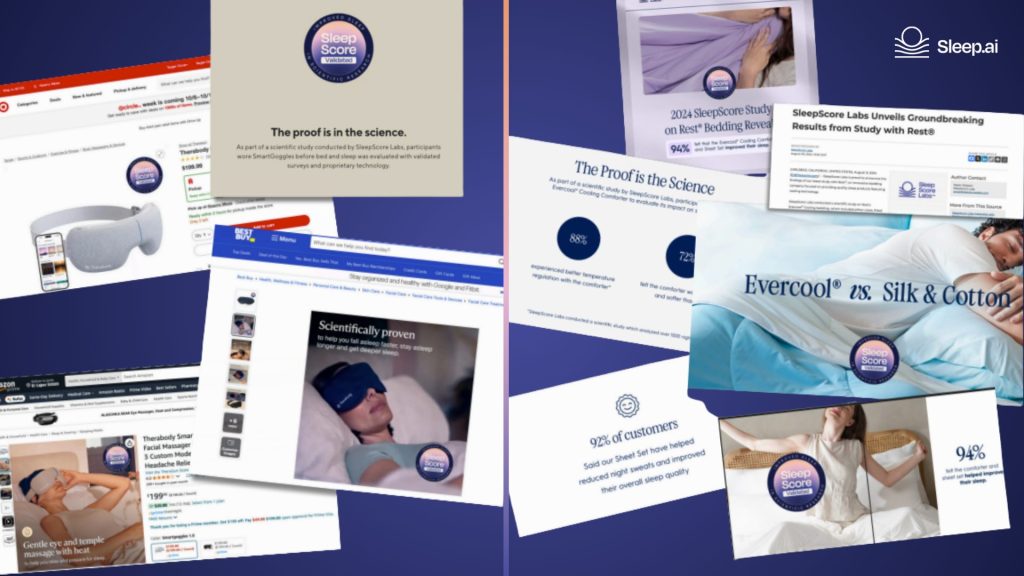
In collaboration with the AgeTech Collaborative™ from AARP, we ran a controlled consumer study to measure one simple question: Does scientific validation actually influence buying behavior?
The answer: Yes — significantly.
To isolate the impact of validation, we designed a controlled A/B consumer survey. Participants were randomly assigned to view:
Version B: Identical product message — without validation
No participant saw both versions, and everything was identical except for one variable: the presence of objective, third-party validation. We then measured trust & confidence, product preference, and purchase intent.
Adding objective, science-based validation meaningfully increased consumer confidence, even when everything else in the ad was identical.
Here’s what changed:
+16% increase in consumers who were Extremely Likely or Likely to purchase
+21% more consumers selected the validated product as their top choice
+11% more said they were ready to buy today
Validation didn’t just improve perception; it changed buying behavior.
When asked what stood out in the product message, 38% said the scientific validation seal was the #1 factor.
This beat brand name, visual design, materials, and personal sleep needs. This confirms our hypothesis that consumers are increasingly skeptical of marketing claims and trust measurable, objective data.
Open-ended responses reinforced the quantitative lift:
“If it was tested by a third party and provided results, I’d be more confident.”
“Real testimonials combined with science make me trust it more.”
“I need proof that it actually improves sleep — not just marketing copy.”
“Validation from a third party signals higher quality and effectiveness.”
If validation alone, with no changes to price, visuals, or messaging, can create:
Double-digit lift in purchase likelihood
Higher product preference
Immediate readiness to buy
Then validation is not just a scientific exercise; it’s a commercial growth lever. In competitive categories like sleep, wellness, and consumer health, third-party validation can:
Increase conversion rates
Improve ad efficiency
Strengthen retail positioning
Reduce reliance on promotional discounting
Elevate brand trust long-term
This survey was conducted in collaboration with the AgeTech Collaborative™ from AARP, reinforcing its relevance to health-conscious consumers, aging demographics, wellness-driven buyers, and science-oriented shoppers.